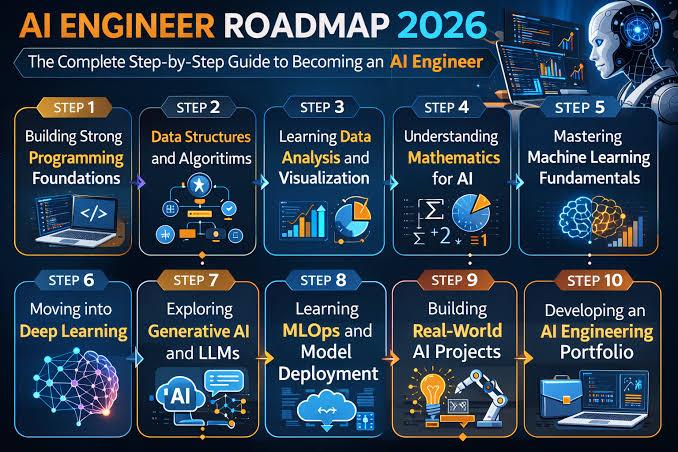
AI has moved from autocomplete to co-worker. Here is how AI-first development actually works in production — and where it still fails.
What AI-First Development Actually Means
AI-first development means treating AI as a core part of your workflow from day one — not an occasional helper. You brief an AI agent to scaffold features, generate components, write tests, and explain unfamiliar code. The developer's job shifts from typing every line to reviewing, architecting and setting constraints.
In practice this looks like: describing a component in natural language, receiving a working draft in seconds, then spending your time on edge cases, accessibility and performance — the parts AI still handles poorly.
The 2026 Tool Landscape
IDE-integrated agents (Cursor, GitHub Copilot, Windsurf) dominate day-to-day coding. CLI agents (Claude Code, Codex) handle multi-file refactors and repo-wide tasks. Design-to-code tools now emit production-ready meta-framework projects instead of throwaway prototypes.
The winning pattern is not picking one tool — it is layering them: an in-editor assistant for velocity, a CLI agent for large changes, and AI code review as a safety net before every merge.
Where AI Genuinely Helps
Boilerplate and scaffolding: forms, API routes, CRUD screens — the work that used to eat a day now takes minutes. Test generation: AI is excellent at writing the tedious edge-case tests humans skip. Onboarding: pointing an agent at an unfamiliar codebase and asking 'how does auth work here?' saves hours of reading.
Documentation, migrations, and dependency upgrades are other areas where AI reliably pays for itself, because the task is well-defined and the output is easy to verify.
Where AI Still Fails
Architecture decisions: AI optimises for the current file, not the system. Security: generated code regularly misses auth checks, injection risks and CSRF protections — review every line that touches data. Performance: AI happily adds a library where ten lines of CSS would do.
The teams getting real value treat AI output as a junior developer's first draft: fast, useful, and never merged without review. The teams getting burned treat it as an oracle.
How to Adopt AI-First Without Regret
Start with low-risk tasks: tests, docs, refactors with existing test coverage. Define review standards before you accelerate: what must every PR have, regardless of who — or what — wrote it. Track outcomes, not vibes: cycle time, defect rate, rollback frequency.
And keep learning the fundamentals. In 2026 the developers who thrive are the ones who understand the platform deeply enough to catch what the machine gets wrong.
Conclusion
AI-first development is no longer optional — but it is also not magic. Treat AI as a fast, tireless junior partner: brief it well, review everything, and keep your own architectural judgment sharp.
I use AI tooling across my client projects to ship faster without cutting corners on quality, performance or security. If you want a website that benefits from modern workflows, let's talk.
Want help with your project?
I build fast, modern and SEO-ready websites. Let's talk about what you need — I usually respond within a few hours.
Get in Touch →
Malik Kashan
Frontend & WordPress Developer · Lahore, Pakistan
I build fast, SEO-ready websites for startups and businesses worldwide using Next.js, React and WordPress.
Hire Me for Your Project